On a humid night in Tbilisi, Spain's midfielders once spent 90 minutes chasing shadows. Georgia, ranked 74th in the world at the time。held the 2010 world champions to a 1-0 defeat in a friendly that few saw coming. That match, played in 2016, still lingers as a reminder: Spain and Georgia share a footballing border that is far more volatile than their FIFA rankings suggest.Spain's identity is possession. Xavi, Iniesta, Busquets—the holy trinity of tiki-taka—turned the national team into a metronome. Georgia's approach is different. Physical, direct。and increasingly organized under coach Willy Sagnol, they rely on quick transitions and set pieces. In their Euro 2024 qualifier in Tbilisi, Georgia frustrated Spain for 70 minutes before a late goal sealed a 1-0 Spanish win. The scoreline flattered Spain. Georgia's defensive block, led by Guram Kashia, absorbed pressure like a sponge, then countered with the pace of Khvicha Kvaratskhelia. That night, Spain's full-backs, Dani Carvajal and Alejandro Grimaldo, were pinned back—a rare sight.What strikes me about this matchup is the contrast in footballing education. Spain's youth academies produce technicians by the dozen. Georgia, with a population of 3.7 million, has fewer resources but a growing diaspora of players in stronger leagues. Kvaratskhelia's rise at Napoli—Serie A MVP in 2023—gave Georgian football a global face. Spain, meanwhile, continues to churn out midfielders like Pedri and Gavi, who treat the ball as a personal possession. When these two meet, it's not just a game of styles;
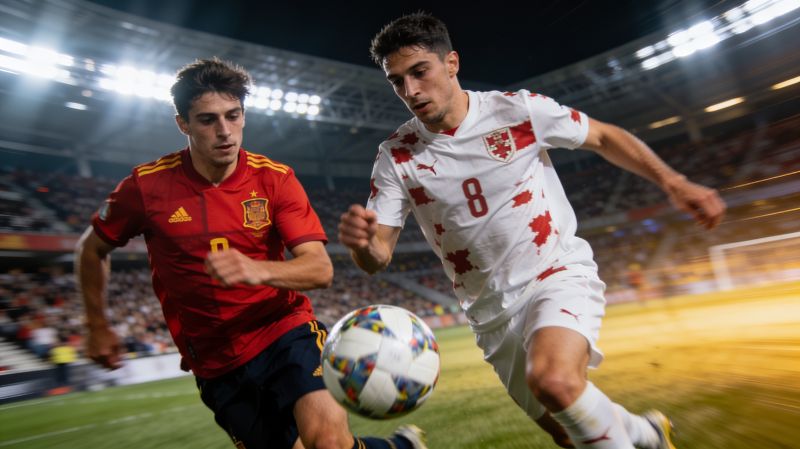
it's a test of systems. Spain's pressing structure, orchestrated by Luis de la Fuente, tries to suffocate Georgia's build-up. Georgia's response?Long balls to the flanks and hoping for a mistake. It's not elegant。
but it's effective enough to keep games tight.Beyond the pitch, the cultural exchange is quieter. Spanish coaches have worked in Georgia's domestic league—former Barcelona assistant Juan Carlos Unzué once consulted for Dinamo Tbilisi. Georgian players, like midfielder Otar Kiteishvili, have trained in Spanish academies. These small bridges matter. They soften the edge of a rivalry that。on paper, seems lopsided. Spain has won four of their six meetings;Georgia has never beaten them in a competitive fixture. Yet the margins are shrinking. In the last two encounters, Georgia lost by a single goal each time. That's progress.Looking ahead。
the fixture carries weight. Spain's golden generation is transitioning;Georgia's is peaking. Kvaratskhelia is 23, goalkeeper Giorgi Mamardashvili is 23, and forward Georges Mikautadze is 23. Spain's core—Rodri, Álvaro Morata, Dani Olmo—is older. The next few years could flip the script. I wouldn't bet on Georgia beating Spain in a major tournament just yet, but the days of predictable scorelines are over. When Spain and Georgia meet, expect sweat, tactical fouls, and at least one moment of individual brilliance. That's the new normal.